Introduction: What Does It Take to Become a GenAI Engineer in 2027?
Generative AI is transforming how businesses build applications, automate workflows, process information, and interact with technology.
From AI-powered chatbots and intelligent document processing to autonomous AI agents, modern applications are increasingly powered by Large Language Models (LLMs).
But becoming a Generative AI Engineer is not just about learning how to use ChatGPT or writing effective prompts.
You need to understand what happens behind the scenes.
How does an LLM understand human language? How does it generate responses? How can you connect an AI model with your company's private data? How do you build AI agents that can independently use tools and execute tasks?
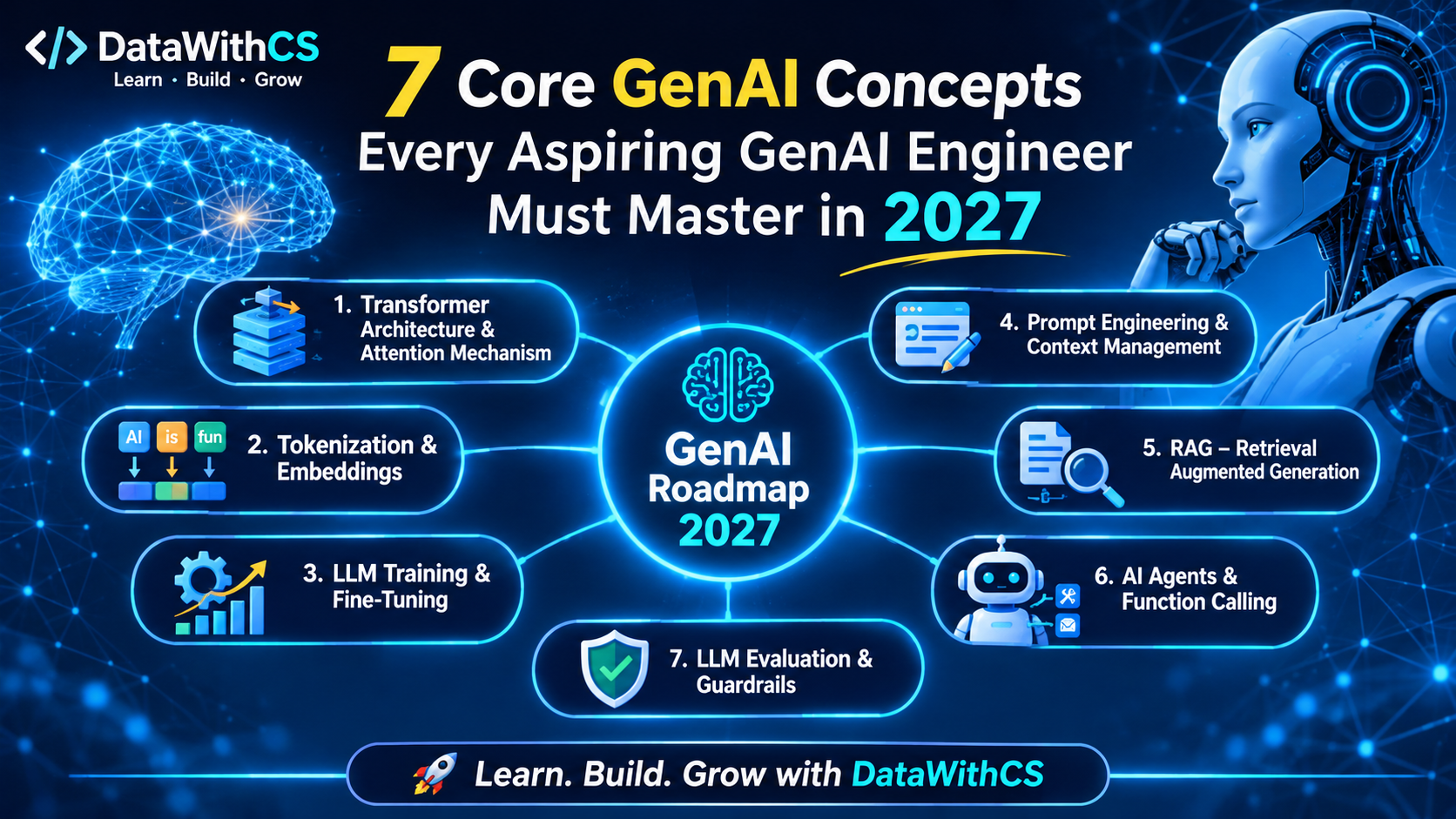
To answer these questions, every aspiring GenAI Engineer should master the following seven core concepts.
Let's explore them one by one.
1. Transformer Architecture & Attention Mechanism
The Transformer architecture is the foundation of most modern Large Language Models.
Introduced in the research paper Attention Is All You Need (2017), Transformers changed how machines process and understand sequential data.
Earlier architectures such as RNNs and LSTMs processed sequences step by step. Transformers introduced an attention-based mechanism that allows models to process relationships between tokens more efficiently.
What is Attention Mechanism?
Imagine reading this sentence:
"The student submitted the assignment because he completed it."
To understand the sentence, you need to identify what "he" and "it" refer to.
Similarly, an AI model needs to understand relationships between different words or tokens in a sentence.
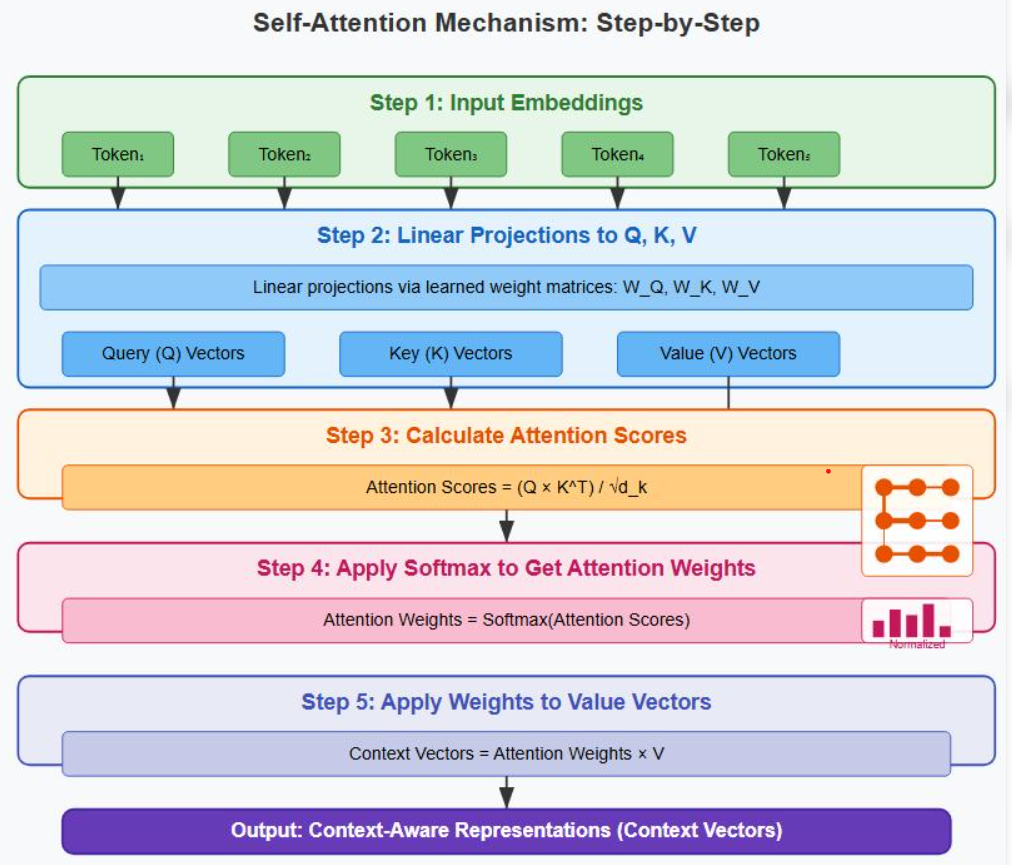
The Attention Mechanism helps an LLM determine which other tokens are important when processing a particular token.
Important concepts to learn:
- Self-Attention
- Query, Key, and Value (Q, K, V)
- Scaled Dot-Product Attention
- Multi-Head Attention
- Positional Encoding
- Encoder and Decoder Architecture
Why does it matter?
Understanding Transformers helps you understand the internal architecture of models such as GPT and other modern LLMs.
Practical learning: Implement a basic Self-Attention mechanism using Python and PyTorch.
2. Tokenization & Embeddings
Before an LLM can process human language, text needs to be converted into a numerical representation.
Computers do not directly understand words the way humans do. Tokenization and Embeddings help bridge this gap.
What is Tokenization?
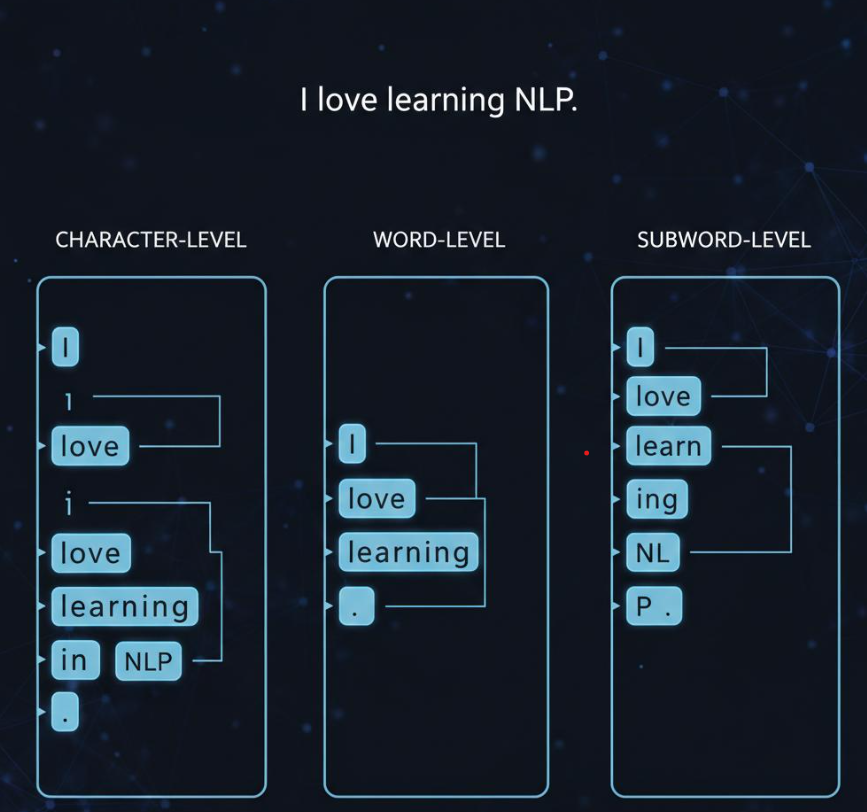
Tokenization is the process of breaking text into smaller units called tokens.
For example:
Input: "Generative AI is transforming technology."
A tokenizer might divide this sentence into tokens such as:
- Generative
- AI
- is
- transforming
- technology
Actual tokenization depends on the model's tokenizer. A word may be divided into multiple subword tokens.
Each token is then mapped to a numerical token ID.
What are Embeddings?
Embeddings convert tokens into dense numerical vectors that represent their learned semantic and contextual properties.
For example, words with related meanings may have similar vector representations in an embedding space.
Embeddings help AI systems work with semantic similarity, search, and contextual relationships.
Important concepts to learn:
- Word and Subword Tokenization
- BPE (Byte Pair Encoding)
- WordPiece and SentencePiece
- Token IDs
- Embedding Vectors
- Vector Dimensions
- Cosine Similarity
Why does it matter?
Tokenization and embeddings are essential for understanding how LLMs process text and how vector databases support semantic search.
Practical learning: Use a Hugging Face tokenizer and generate embeddings using a sentence-transformer model.
3. LLM Training & Fine-Tuning
How does an AI model learn to generate human-like responses?
The answer lies in the training process.
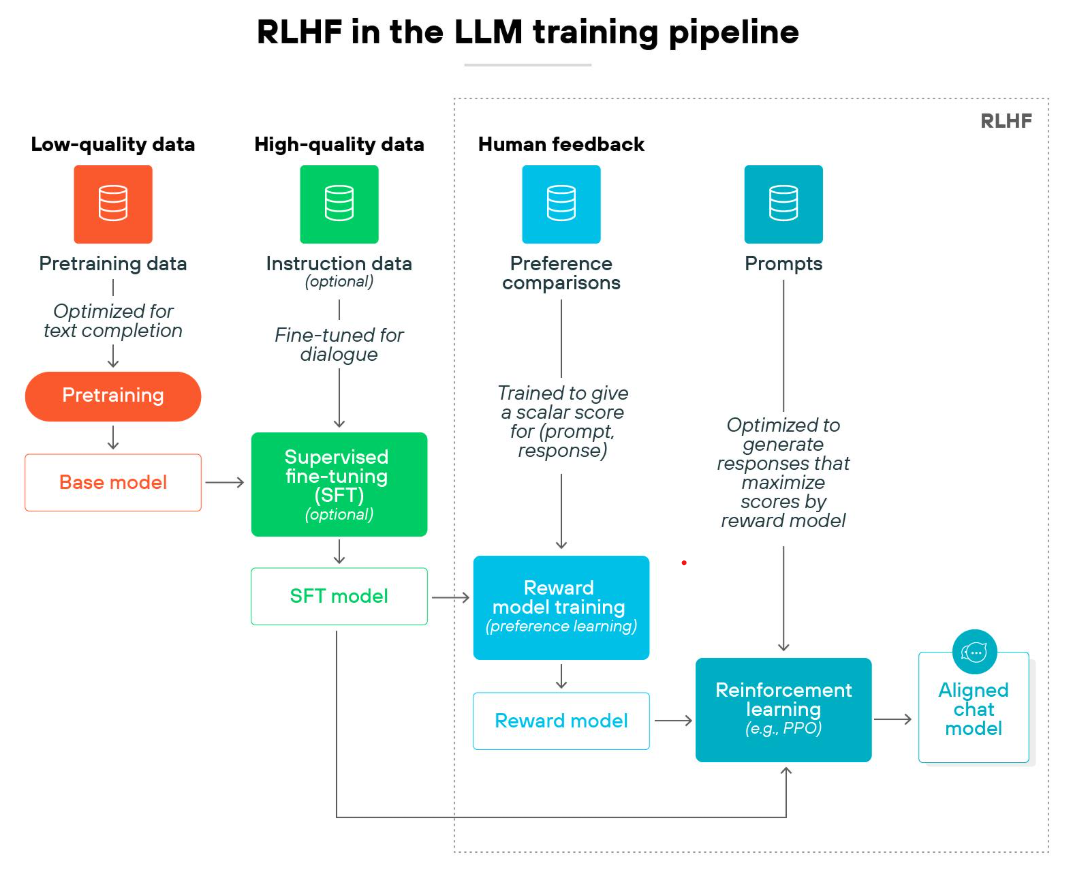
Large Language Models go through different training stages to learn language patterns, generate meaningful responses, and follow instructions.
A. Pre-training
Pre-training is the initial stage where an LLM learns from large amounts of text data.
The model learns statistical patterns in language, often by predicting the next token based on the preceding context.
For example:
Input: "Artificial Intelligence is..."
The model learns to predict a likely next token based on its training.
B. Supervised Fine-Tuning (SFT)
After pre-training, a model can be fine-tuned using curated examples of instructions and appropriate responses.
This helps the model become better at following user instructions and performing specific tasks.
C. RLHF (Reinforcement Learning from Human Feedback)
RLHF uses human preferences to improve model responses.
Human evaluators compare model-generated responses, and their preferences help train the model to produce more useful and aligned outputs.
Modern preference-optimization approaches can also use methods such as Direct Preference Optimization (DPO).
Important concepts to learn:
- Pre-training
- Next-Token Prediction
- Supervised Fine-Tuning
- Instruction Tuning
- RLHF
- Reward Models
- DPO
- LoRA and QLoRA
- Parameter-Efficient Fine-Tuning (PEFT)
Why does it matter?
As a GenAI Engineer, you should understand when to use an existing foundation model, when to fine-tune it, and when prompt engineering or RAG is a better solution.
Practical learning: Fine-tune a small open-source language model using a curated instruction dataset.
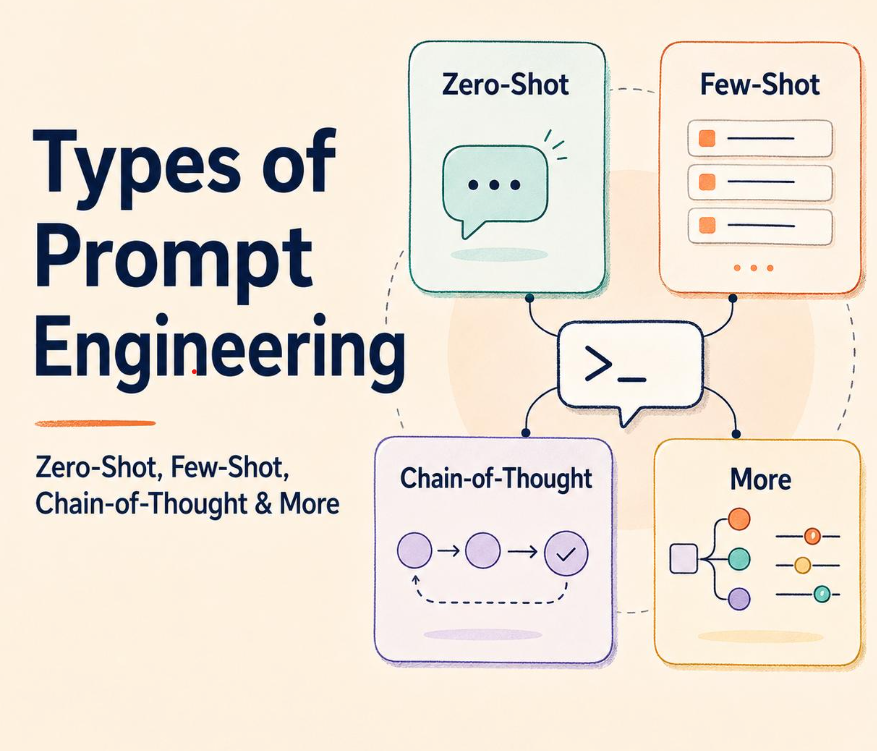
4. Prompt Engineering & Context Management
Prompt Engineering is the process of designing effective instructions to guide an LLM toward the desired output.
Even powerful AI models can produce inaccurate or irrelevant responses when they receive unclear instructions or insufficient context.
Important Prompt Engineering Techniques
1. Zero-Shot Prompting
Giving the model an instruction without providing examples.
Example: "Summarize this article in five bullet points."
2. Few-Shot Prompting
Providing a few examples to demonstrate the expected output format or behavior.
3. Role-Based Prompting
Assigning a role to the AI model.
Example: "Act as a Senior Data Analyst and explain this SQL query."
4. Structured Prompting
Using clear sections, instructions, constraints, and expected output formats.
5. Chain-of-Thought and Reasoning Approaches
Understanding how reasoning-oriented prompting and models can improve performance on complex tasks. Internal reasoning should not be confused with a guaranteed explanation of a model's actual decision process.
What is Context Management?
Context management means controlling the information available to an LLM during a conversation or task.
Important concepts include:
- Context Windows
- System Prompts
- Conversation History
- Context Length
- Token Limits
- Context Compression
- Prompt Templates
Why does it matter?
A GenAI Engineer must know how to design prompts and manage context to build reliable AI applications.
Practical learning: Build a prompt-based application that converts unstructured business requirements into structured JSON output.
5. RAG – Retrieval Augmented Generation
One of the most important concepts in modern GenAI application development is Retrieval Augmented Generation (RAG).
Imagine building an AI chatbot for a company.
The company wants employees to ask questions about internal policies, HR documents, training manuals, and business reports.
A general-purpose LLM may not have access to these private documents.
This is where RAG becomes useful.
What is RAG?
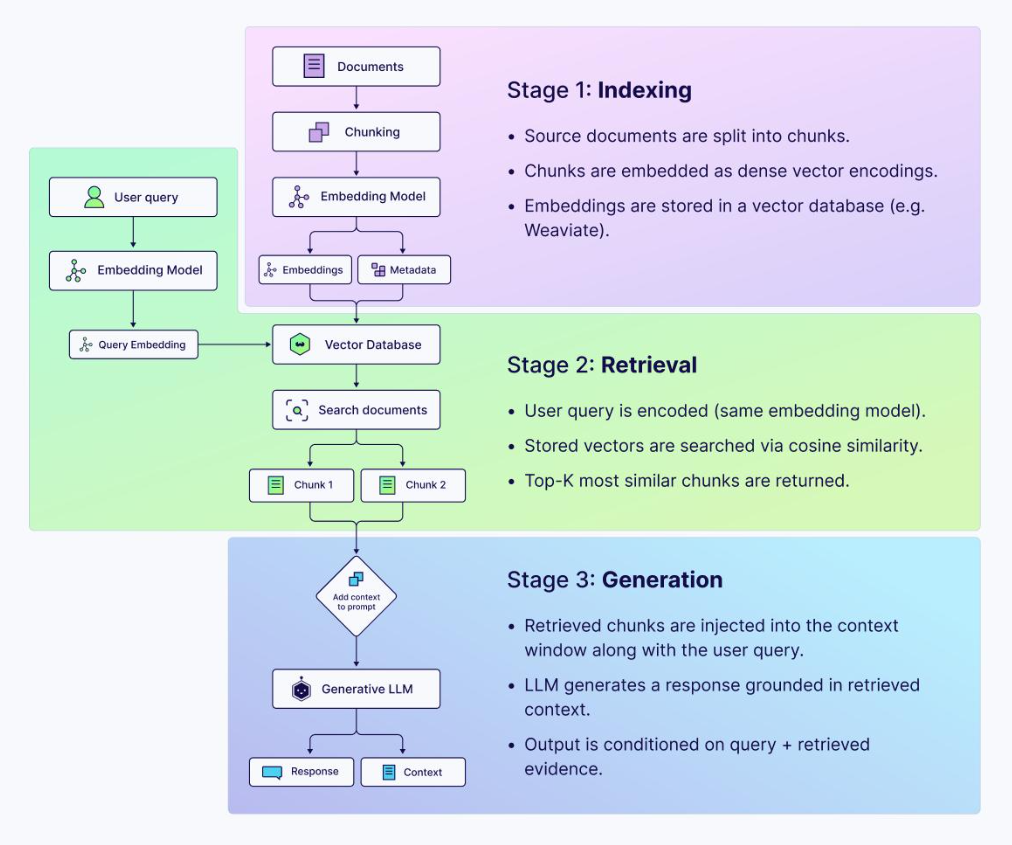
RAG combines information retrieval with LLM-based generation.
Instead of relying only on the model's pre-trained knowledge, the system retrieves relevant information from an external knowledge source and provides it as context to the LLM.
How Does RAG Work?
Step 1: Document Loading
Load documents such as PDFs, Word files, websites, and text files.
Step 2: Chunking
Break large documents into smaller meaningful sections.
Step 3: Embedding Generation
Convert document chunks into numerical vectors.
Step 4: Vector Storage
Store embeddings in a vector database.
Step 5: Retrieval
When a user asks a question, retrieve the most relevant document chunks using similarity search or other retrieval techniques.
Step 6: Generation
Pass the retrieved context and user question to an LLM to generate a grounded response.
Important concepts to learn:
- Document Loaders
- Text Chunking
- Embedding Models
- Vector Databases
- Similarity Search
- Semantic Search
- Metadata Filtering
- Hybrid Search
- Reranking
- Retrieval Evaluation
Popular tools and technologies:
- LangChain
- LlamaIndex
- FAISS
- Chroma
- Pinecone
- PostgreSQL with pgvector
Why does it matter?
RAG is widely applicable in enterprise AI applications, including document intelligence, knowledge assistants, customer support, and internal search systems.
Practical learning: Build a PDF-based AI chatbot that answers questions using uploaded documents and provides source references.
6. AI Agents & Function Calling
Traditional AI chatbots primarily respond to user queries.
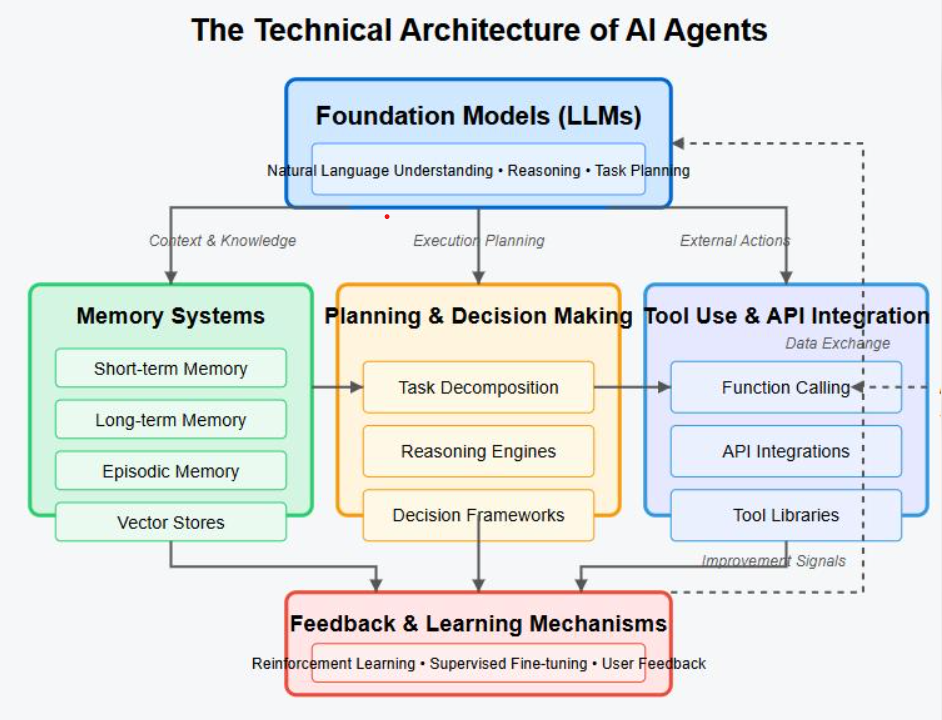
AI Agents go a step further by interacting with tools, making decisions, and executing multi-step tasks.
Imagine asking an AI assistant:
"Analyze this sales report, calculate monthly revenue, identify the best-performing product, and prepare a summary."
An AI Agent can be designed to:
- Understand the user's objective.
- Identify the required steps.
- Call a Python tool to analyze the data.
- Retrieve additional information if required.
- Generate a final report.
What is Function Calling?
Function Calling allows an LLM to request the execution of predefined functions or tools.
For example, an AI application might provide tools such as:
- get_weather()
- calculate_revenue()
- search_database()
- send_email()
The model identifies when a tool is needed and produces a structured tool call. The application executes the function and returns the result to the model.
What are AI Agents?
An AI Agent is a system that uses an AI model to decide what actions to take toward a defined objective, often using external tools and maintaining task context.
Important concepts to learn:
- Function Calling
- Tool Calling
- Agent Planning
- Tool Selection
- Agent Memory
- Multi-Step Execution
- Multi-Agent Systems
- Human-in-the-Loop
- Agent Workflows
Popular frameworks:
- LangGraph
- LangChain
- CrewAI
- AutoGen
- OpenAI Agents SDK
Why does it matter?
AI Agents are becoming an important part of business automation, intelligent workflows, and AI-powered enterprise applications.
Practical learning: Build an AI research assistant that searches information, summarizes findings, and generates a report using external tools.
7. LLM Evaluation & Guardrails
Building an AI application is only the beginning.
How do you know whether your AI application is giving correct answers?
How do you prevent it from generating harmful, irrelevant, or unsupported information?
This is where LLM Evaluation and Guardrails become important.
What is LLM Evaluation?
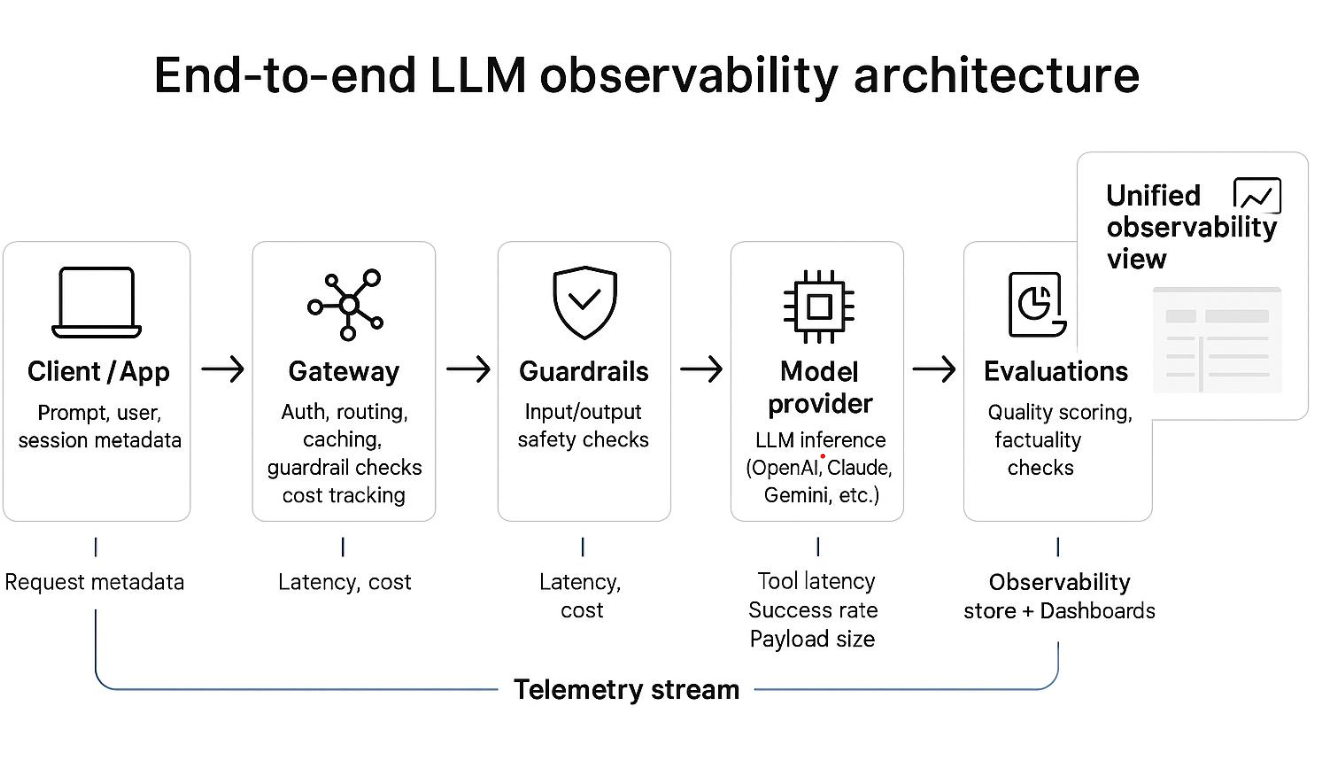
LLM Evaluation is the process of measuring the quality, accuracy, reliability, and performance of AI-generated responses.
For a RAG application, you should evaluate both retrieval quality and response quality.
Important evaluation metrics:
- Answer Relevance
- Faithfulness
- Context Precision
- Context Recall
- Response Quality
- Latency
- Token Usage
- Cost Per Request
What are Guardrails?
Guardrails are mechanisms used to control and validate AI system behavior.
They help ensure that an application follows defined rules, handles unsafe inputs, and produces outputs in acceptable formats.
Important concepts to learn:
- Hallucination Detection
- Input Validation
- Output Validation
- Content Filtering
- Prompt Injection Protection
- PII Detection
- Structured Output Validation
- Human Review
- LLM Observability
Popular tools:
- Ragas
- DeepEval
- LangSmith
- Arize Phoenix
- Guardrails AI
Why does it matter?
Enterprise AI applications need more than impressive responses. They need reliability, security, measurable performance, and consistent behavior.
Practical learning: Evaluate your RAG chatbot using a test dataset and implement validation checks for generated responses.
How to Connect These 7 Concepts into One GenAI Project
Learning individual concepts is important, but becoming a GenAI Engineer requires applying them together.
Consider building an Enterprise Knowledge Assistant.
Your application could work like this:
- Use an LLM to understand user queries.
- Use tokenization and embeddings to represent text.
- Use a RAG pipeline to retrieve relevant company documents.
- Use prompt engineering to provide the right context.
- Use function calling to interact with external tools.
- Use AI Agents to execute multi-step tasks.
- Use evaluation and guardrails to improve reliability and safety.
This project will help you understand how modern GenAI applications are designed and developed.
Recommended Learning Resources
Here are some resources to strengthen your understanding of these concepts:
1. Transformer Architecture
- Attention Is All You Need – Original Research Paper
- The Illustrated Transformer – Jay Alammar
2. Tokenization & Embeddings
- Hugging Face NLP Course
- Sentence Transformers Documentation
3. LLM Training & Fine-Tuning
- Hugging Face Transformers Documentation
- PEFT Documentation
4. Prompt Engineering
- OpenAI Prompt Engineering Guide
- Anthropic Prompt Engineering Documentation
5. RAG
- LangChain Documentation
- LlamaIndex Documentation
6. AI Agents
- LangGraph Documentation
- OpenAI Agents SDK Documentation
7. LLM Evaluation & Guardrails
- Ragas Documentation
- DeepEval Documentation
- LangSmith Documentation
Final Thoughts: Start Building, Not Just Learning
Generative AI is evolving rapidly, and the demand for engineers who can build practical AI applications is growing.
If you want to become a GenAI Engineer in 2027, don't limit yourself to using AI tools.
Understand the underlying architecture, learn how LLMs process information, build RAG pipelines, experiment with AI Agents, and evaluate your applications.
Most importantly, build real-world projects.
At DataWithCS, our focus is on helping learners move beyond theoretical knowledge and develop practical skills through industry-oriented learning, hands-on projects, and mentorship.
Your journey toward becoming a GenAI Engineer starts with understanding these seven concepts.
Learn. Build. Experiment. Grow with DataWithCS.
Note : Image references sourced from the internet for educational and visual guidance; all images are used for illustrative purposes.