₹20,000₹25,000
Includes a ₹5,000 registration fee
Enroll NowThis course includes
- Live instructor-led sessions
- 4 Months of training
- 70 lectures
- 8 hands-on projects
Lifetime access to course materials
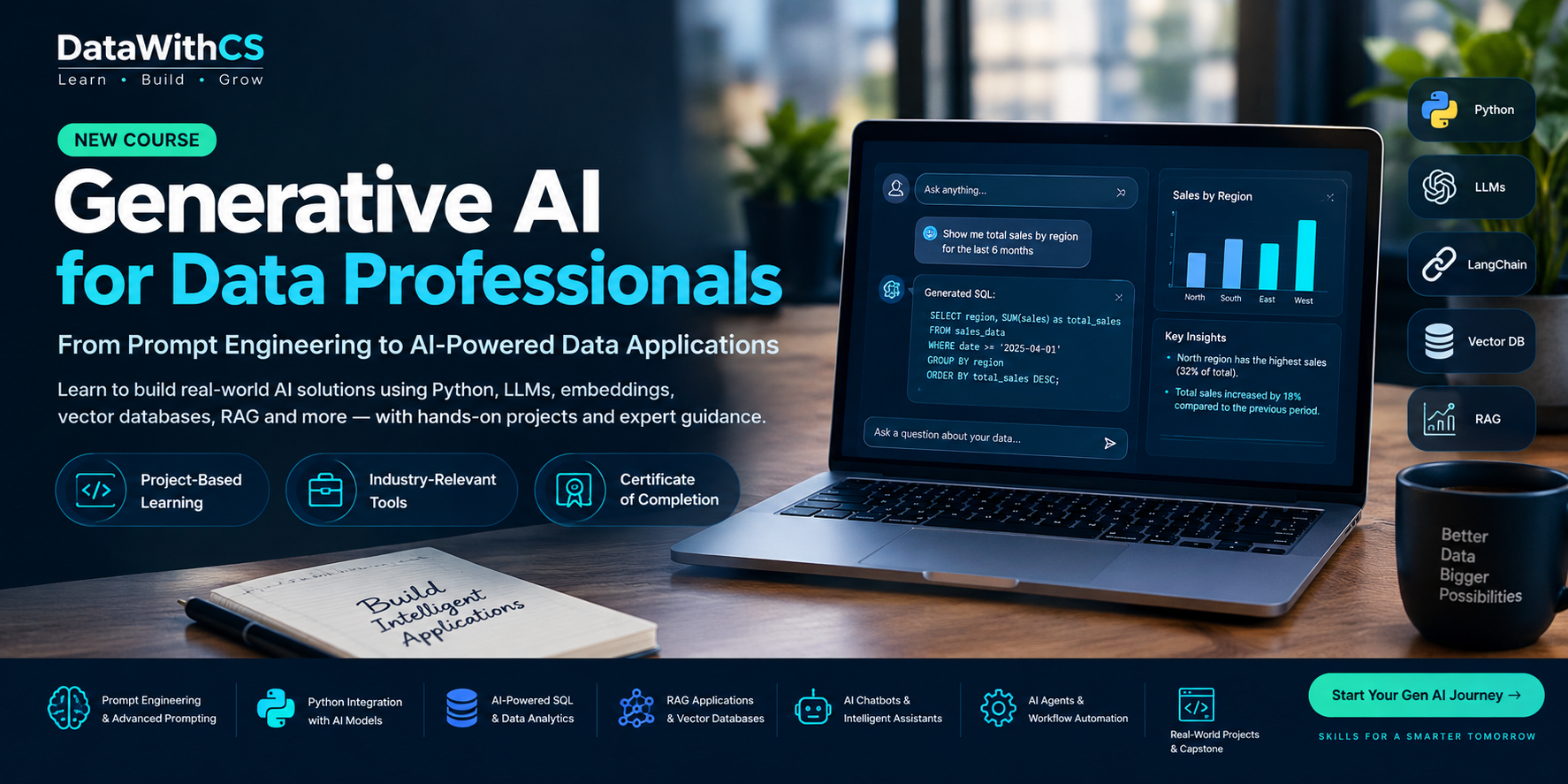
Generative AI is transforming how businesses analyze information, automate workflows, and build intelligent applications. This practical, project-based program helps learners move beyond basic AI tools and understand how to build real-world solutions using Large Language Models (LLMs). Starting with prompt engineering and LLM fundamentals, learners progress to Python-based AI applications, structured data interaction, embeddings, vector databases, Retrieval-Augmented Generation (RAG), and AI-powered assistants. By the end of the program, learners will have hands-on experience building AI applications that solve practical business and data problems.
Generative AI is a type of artificial intelligence that can generate text, code, images, and other content. It powers applications such as AI chatbots, coding assistants, and intelligent business tools.
This course is suitable for students, working professionals, Data Analysts, Data Engineers, Data Scientists, and Python developers who want to develop practical Generative AI skills.
No prior AI or Machine Learning experience is required. Basic Python programming knowledge is recommended to get the most out of the hands-on exercises.
You will learn prompt engineering, Large Language Models (LLMs), Python integration, AI APIs, embeddings, vector databases, Retrieval-Augmented Generation (RAG), AI chatbots, and introductory AI agents.
Yes. You will work on practical projects such as an AI SQL Assistant, a document question-answering chatbot, and an AI-powered Business Insights Assistant.
The course may cover Python, LLM APIs, LangChain, LlamaIndex, ChromaDB, FAISS, Streamlit, SQL, and other tools used to develop Generative AI applications.
RAG is a technique that enables an AI application to retrieve relevant information from external documents or knowledge sources before generating a response. It helps create more context-aware applications grounded in provided information.
The course can help you develop practical skills for building AI-powered applications and strengthen your profile for opportunities involving Generative AI, data analytics, Python development, and LLM application development. Career outcomes depend on your existing skills and experience.
Students who meet DataWithCS's course-completion requirements can receive a certificate of completion. Any applicable attendance, assessment, and project requirements will be communicated during enrollment.
Visit the DataWithCS website to explore the course and contact the team for information about upcoming batches, fees, schedules, and enrollment. You can also request a demo session to understand the learning approach before joining.
Talk to a counselor and find out which batch fits your schedule and goals.
Includes a ₹5,000 registration fee
Enroll NowThis course includes
Lifetime access to course materials